
It is said that the secret of the still and distillation was discovered in Roussillon, Perpignan, at the end of the 13th century, by Arnau de Villanova, physician to the Kings of Majorca.
He had the idea of adding distilled wine to fermenting must and developed this stabilization technique called mutage.
Adding this amount of alcohol (around 5 to 10% of the volume) stops the fermentation. The advantage of this process is to preserve some of the natural sugars of the grapes while stabilizing the alcohol content between 15 and 18 degrees.
Banyuls Winemaking
This mutage step varies depending on the type of Vin Doux Naturel and can be done with or without maceration.
Red grape varieties are often vinified by must maceration. This period of contact between the alcohol and the skin allows for a marked extraction of aromas and color. This is more commonly known as mutage on skins.
For white grape varieties, mutage is generally carried out after pressing to avoid the very marked coloration of the juices when there is maceration. This is known as mutage on juice.
The aging and maturation methods depend on the type of Banyuls produced (Rimage, Banyuls, or Banyuls Grand Cru).
For traditional Banyuls and Banyuls Grand Cru, aging is done in an oxidative environment.
Aging and Maturation of Banyuls
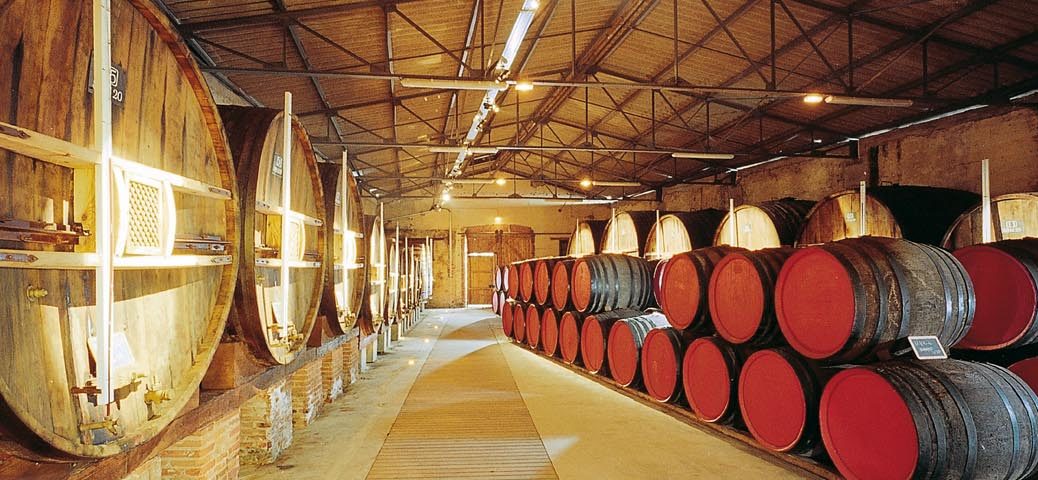
The wines are aged in wood (vats, tanks, barrels, or demi-muids). The wine is left in contact with oxygen. This oxidation is sometimes accelerated by open-air aging.
Sometimes, Banyuls wines are placed in glass carboys or demi-muids stored outdoors. They are thus exposed to thermal variations and sun radiation, which will accelerate the effects of "aging". They are kept for up to a year under these conditions then bottled or blended in wooden vats where aging continues for several years or even several decades.
This type of aging causes a marked change in the color of the wines. White wines generally become amber, and reds take on a brick-red hue.
Fruit aromas mature then give way to a very rich aromatic complex of dried fruits, tobacco, leather, spices…
The minimum wood aging period is 10 months for traditional Banyuls and 30 months for Banyuls Grand Cru.
Extensive aging allows for the characteristic rancio aroma of some Banyuls wines.
For Rimage Banyuls and certain white Banyuls, aging is done in a reductive environment, i.e., without oxygen.
The wines are aged while being protected from any oxidation. Early bottling can be carried out after storage in perfectly topped-up tanks, or the wine's structure can be enhanced by more or less prolonged aging in barrels and later bottling. The goal here is to preserve the aromatic freshness and fruitiness of the Banyuls. For Rimage Banyuls, the minimum aging period is 12 months.
The specific characteristics of each vintage will define its evolution and aging potential.


