
More info on the website: Domaine Puig-Parahy
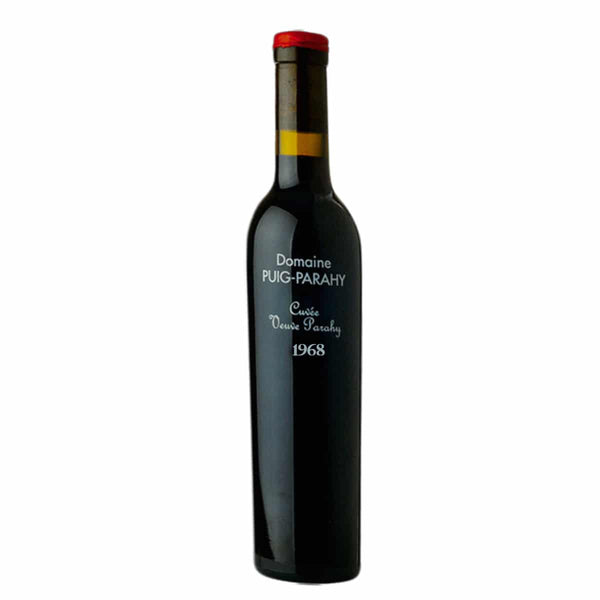
Tasting notes for Rivesaltes 1968 – Puig-Parahy
- This 1968 Rivesaltes has a honey-colored hue with bright reflections that suggest a dry rancio aroma.
- Powerful nose with very marked notes of hazelnuts and raisins.
- Its palate has an attack well marked by a Muscat tone that remains very present.
- The finish of this 1968 Rivesaltes is long and intense, dominated by rancio aromas. This vintage Rivesaltes received a score of 18/20 from the Revue de Vins de France.
Domaine Puig-Parahÿ Rivesaltes 1968
The entire Cap Vintage team is proud to open its range of Vins Doux Naturels with the Rivesaltes from Domaine Puig-Parahy.Few estates can boast such consistency over time, such continuity within the family fold, for nearly 7 centuries of history. We invite you to discover and taste this world that tells its story over more than 50 Rivesaltes vintages since 1875!
Rivesaltes 1968
The vinification of Vins Doux Naturels comes from Muscats grown between land and sea, in the valleys of the Aspres bordering the fertile Roussillon plain. These valleys shelter one of the hottest and most arid climates in France, which, together with work on yields, confers all the power and characteristic nobility of the Vins Doux Naturels produced in this region. In addition to the great history of Vins Doux Naturels, Domaine Puig-Parahÿ has evolved its estate by diversifying grape varieties and winemaking methods to offer a wide range of wines.In 1994, Georges Puig inherited the estate's vines. The soils are very varied: the first land is dominated by clay-limestone, the second by stony soil, and the last by a schist massif. This diversity of terroirs allows for a varied grape variety: Carignan, Grenache Noir, Gris, and Blanc, Muscat of Alexandria, Macabeu, Mourvèdre, and Muscat à Petits Grains.
Yields averaged 40 hectoliters per hectare, but continue to decrease due to the aging of the vines. For this reason, the Château has been replanting other vines for several years, also introducing new grape varieties such as Syrah.
You might also like
Product title
Vendor
€19,99 | €24,99
Product title
Vendor
€19,99 | €24,99
Product title
Vendor
€19,99 | €24,99
Product title
Vendor
€19,99 | €24,99

48-hour express delivery
Enjoy free delivery from €300 of purchases in mainland France.

100% secure payment
Pay with peace of mind thanks to our secure server.
