
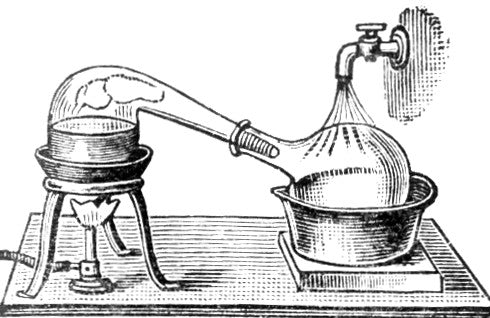
Distillation & Still
For the connoisseurs, a short article on distillation on the CAP Vintage blog.
Armagnac: from vineyard to still
Armagnac, like Cognac, is a wine spirit. Its history begins in the vineyards.
To obtain the wine that will then be transformed into Armagnac, the AOC Armagnac specifications authorize about ten white grape varieties. In practice, four grape varieties are mainly used:
–Ugni Blanc, which developed widely thanks to its resistance after the phylloxera crisis. It allows obtaining wines with a low alcohol content and a certain acidity.
–Baco, resistant and which allows obtaining very aromatic distillates
–Folle Blanche, the historical grape variety of Armagnac which allows obtaining beautiful floral notes, but which remains very fragile and sensitive to rot.
–Colombard, widely used for wines of the IGP Côtes de Gascogne appellation. For the elaboration of Armagnac, it brings a spicy touch during blending.
Armagnac – Still and continuous distillation
After harvesting, the grapes are vinified naturally because the AOC Armagnac does not authorize enrichment or the use of sulfites.
Then comes the very particular stage of distillation.
The Armagnac still – a regional particularity
The obtained wine is generally distilled on site directly at the property. Not all producers have their own distillation unit, so a "mobile distiller" is sometimes called upon, who tours the cellars to offer this distillation service to winemakers.
Unlike Cognac, which is produced with a double distillation technique, Armagnac is generally conceived by single distillation, also called "simple chauffe" (only about 5% of production is done using the double technique).
This "regional" distillation technique, patented in 1818, has evolved over the years. It consists of boiling the wine in a pure copper still. The wine constantly feeds the still on the lower part of the cooling tank (hence its name "continuous distillation").
This cooling tank allows the alcohol vapors to condense in the coil.
The wine heats in the lower part and the vapors produced feed the distillation column. These vapors pass through the different plates of the distillation column. In the upper part of the column, they reach the swan neck and pass into the coil in which they will gradually cool to form the spirit.
The obtained distillate is colorless and has an alcohol content of between 52 and 60 degrees. It is rich in aromas thanks to the numerous exchanges between the vapors and the wine throughout the distillation process.
Follow us on Facebook


